
Snap Circuits Manual: A Comprehensive Guide
Snap Circuits, gaining traction since 2025, inspires creators with its intuitive design. Discussions revolve around projects like Bytebeat music and space-invader games, showcasing its versatility.
Snap Circuits represent a revolutionary approach to electronics education, offering a hands-on learning experience without the complexities of traditional soldering or wiring. Emerging as a popular platform since early 2025, evidenced by enthusiastic forum participation, these kits empower individuals of all ages to explore the fascinating world of circuits. The core appeal lies in its simplicity – components snap together, making project building accessible even to beginners.
Recent discussions highlight the vibrant community surrounding Snap Circuits, with users sharing innovative projects ranging from musical creations like Bytebeat to interactive games such as space-invader style adventures. This collaborative spirit fosters learning and encourages experimentation. The platform’s adaptability, including its PWA installable option for offline access, further enhances its educational value, allowing for uninterrupted exploration and project development. It’s a gateway to understanding fundamental electronic principles in a fun and engaging manner.
What are Snap Circuits?
Snap Circuits are electronic learning kits comprised of pre-built components that connect together with a simple snap-in mechanism. Unlike traditional circuit building requiring soldering and wiring, Snap Circuits eliminate these barriers, making electronics accessible to a wider audience. These kits typically include resistors, LEDs, transistors, integrated circuits, and other essential components mounted on plastic snaps.
The system’s design allows users to follow project guides within the manual, or to experiment and create their own circuits. Discussions from 2025 demonstrate the platform’s versatility, supporting projects from simple light-up circuits to more complex creations like digital voice recorders and even Bytebeat music generators. The intuitive nature of Snap Circuits encourages exploration and fosters a deeper understanding of electronic principles. Furthermore, the availability of a PWA option enhances usability, allowing offline project work.
The History of Snap Circuits
Snap Circuits emerged as a revolutionary approach to electronics education, simplifying complex concepts for beginners. While precise origins aren’t detailed in the provided snippets, the platform’s growing popularity is evident from discussions dating back to 2024 and continuing into 2025. Early adopters quickly embraced the snap-together design, appreciating its ease of use compared to traditional methods.
The evolution of Snap Circuits has been marked by continuous development and community engagement. Online forums demonstrate a vibrant user base sharing projects and troubleshooting tips. The introduction of features like the installable PWA in late 2024 further expanded its accessibility, enabling offline functionality. The platform’s ability to support diverse projects, from simple circuits to Bytebeat music and space-invader games, highlights its adaptability and enduring appeal within the maker community.
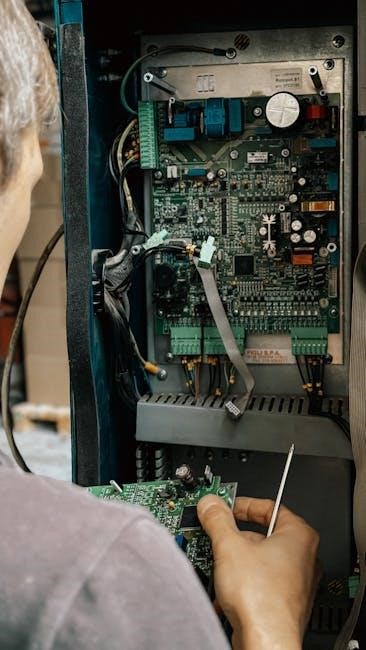
Core Components & Their Functions
Snap Circuits utilizes fundamental components like LEDs and transistors, enabling diverse projects. Discussions showcase building radios and sound-activated switches, demonstrating practical applications.
Resistors and Their Role
Resistors are foundational components in Snap Circuits, playing a crucial role in controlling the flow of electrical current. They limit current, preventing damage to other components like LEDs and integrated circuits. Different colored bands on a resistor indicate its resistance value, measured in Ohms (Ω). Understanding resistance is key to building functional circuits.
In Snap Circuits, resistors are often used in series with LEDs to reduce the voltage and current reaching the LED, ensuring it doesn’t burn out. They can also be used to create voltage dividers, providing specific voltage levels for different parts of a circuit. The selection of the correct resistor value is vital for optimal circuit performance. Discussions within the Snap Circuits community often highlight the importance of understanding Ohm’s Law (Voltage = Current x Resistance) when troubleshooting or designing new projects. Properly utilizing resistors ensures circuit stability and longevity, allowing for successful experimentation and learning.
LEDs: Light Emitting Diodes Explained
LEDs (Light Emitting Diodes) are semiconductor devices that emit light when an electric current passes through them. In Snap Circuits, LEDs are commonly used to visually indicate circuit activity or to create light-based projects. They have a positive (anode) and a negative (cathode) lead, and must be connected correctly to function – reverse polarity will prevent illumination.
Because LEDs require a specific voltage and current to operate safely, they are frequently used in conjunction with resistors. As previously discussed, resistors limit the current flowing through the LED, preventing it from being damaged. Different colored LEDs have varying forward voltage requirements. The Snap Circuits manual emphasizes the importance of understanding LED polarity and current limitations. Successful projects often involve strategically placing LEDs to provide clear visual feedback, enhancing the learning experience and demonstrating fundamental electronic principles. Experimentation with LEDs is a core aspect of Snap Circuits exploration.
Transistors: Switching and Amplification
Transistors are fundamental semiconductor devices acting as either electronic switches or amplifiers. Within Snap Circuits, they enable more complex functionalities beyond simple connections, allowing for projects like sound-activated switches and potentially, more advanced signal processing. They control the flow of electrical current between two terminals based on a smaller current applied to a third terminal.
In switching applications, a small current can control a larger current, effectively turning a circuit on or off. As amplifiers, transistors increase the strength of a signal. Snap Circuits utilizes transistors to demonstrate these principles in a simplified, hands-on manner. Understanding transistor operation is crucial for building projects that respond to external stimuli or require signal boosting. The manual guides users through configurations demonstrating both switching and amplification, fostering a deeper understanding of electronic control and signal manipulation. Experimentation with transistors unlocks more sophisticated circuit designs.
Integrated Circuits (ICs) in Snap Circuits
Integrated Circuits (ICs) are the heart of many Snap Circuits projects, encapsulating complex electronic functions within a single chip. These pre-built circuits offer functionalities like sound generation, timing, and logic operations, simplifying project construction. Unlike discrete components, ICs integrate numerous transistors, resistors, and capacitors onto a small silicon substrate.
Snap Circuits leverages ICs to introduce users to advanced electronic concepts without requiring deep knowledge of individual component interactions. For example, ICs are vital in building a digital voice recorder or a radio receiver. The manual clearly illustrates how to connect and utilize these ICs, explaining their specific roles within a circuit. Understanding IC pinouts and functions is key to successful project completion. Utilizing ICs allows for building more complex and interactive projects, expanding the learning possibilities beyond basic circuit principles and fostering a greater appreciation for modern electronics.

Building Basic Circuits
Snap Circuits simplifies learning electronics through intuitive connections. Projects like space-invader games demonstrate fundamental principles, while understanding schematics unlocks more complex builds.
Understanding Schematics
Snap Circuits relies heavily on schematics, visual representations of electronic circuits. These diagrams aren’t intimidating; they’re designed for accessibility, mirroring the physical layout of the components. Each component is represented by a simple symbol, making it easy to translate the schematic into a real-world build.
Understanding these symbols is crucial. A straight line typically represents a wire, connecting components. Components like resistors, LEDs, and transistors each have unique symbols. The manual provides a comprehensive key, detailing each symbol’s function. Following a schematic is like following a recipe – each step builds upon the last.

Beginners should start with simple schematics, gradually increasing complexity. Pay close attention to component orientation; some components, like LEDs, are polarity-sensitive. Incorrect orientation can prevent the circuit from functioning. Practice tracing the circuit path with your finger before building, visualizing the flow of electricity. Mastering schematics unlocks the full potential of Snap Circuits, enabling you to build increasingly sophisticated projects.
Series vs. Parallel Circuits
Snap Circuits allows exploration of fundamental circuit configurations: series and parallel. In a series circuit, components are connected end-to-end, forming a single path for current flow. If one component fails, the entire circuit breaks. Think of old-fashioned Christmas lights – one bulb out, they all go dark!
Parallel circuits, conversely, offer multiple paths for current. Components are connected side-by-side. If one component fails, the others continue to function. Modern Christmas lights utilize parallel circuits for this reason. The total resistance in a parallel circuit is lower than in a series circuit with the same components.
Understanding these differences is key to designing effective circuits. Series circuits are useful for voltage division, while parallel circuits are ideal for distributing current. Snap Circuits provides a safe and intuitive way to experiment with both configurations, observing the impact on circuit behavior. Building both types reinforces core electrical engineering principles.
Voltage, Current, and Resistance
Snap Circuits beautifully illustrates the relationship between voltage, current, and resistance – the cornerstones of electrical circuits. Voltage, measured in volts, represents the electrical potential difference, the “push” that drives electrons. Current, measured in amperes (amps), is the flow of electrons through the circuit. Resistance, measured in ohms, opposes this flow.
Ohm’s Law, a fundamental principle, defines this relationship: Voltage = Current x Resistance (V = IR). Increasing voltage increases current, while increasing resistance decreases current. Snap Circuits components, like resistors, directly demonstrate resistance’s effect.
By building circuits with varying components, you can observe how changing voltage (battery size) or resistance (different resistor values) impacts current flow. This hands-on experience solidifies understanding far beyond theoretical concepts. Exploring these concepts with Snap Circuits builds a strong foundation for further electrical exploration.

Advanced Snap Circuit Projects
Snap Circuits empowers complex builds like radios, sound-activated switches, and digital voice recorders, expanding beyond basic functionality. These projects challenge builders and deepen understanding.
Building a Radio
Constructing a functional radio with Snap Circuits represents a significant leap in project complexity, demanding a solid grasp of core electronic principles. This project typically involves assembling a circuit capable of receiving Amplitude Modulation (AM) radio signals, converting them into audible sound. Key components include an antenna to capture radio waves, a tuning circuit to select a specific frequency, and an amplifier to boost the weak signal.
The Snap Circuits manual provides detailed step-by-step instructions and a clear schematic for building this radio. Careful attention must be paid to component placement and ensuring secure connections, as even minor errors can prevent the radio from functioning correctly. Understanding the role of each component – resistors, capacitors, inductors, and diodes – is crucial for troubleshooting and potential modifications. Successfully building a radio demonstrates a practical application of electronic theory and offers a rewarding experience for budding engineers.
Furthermore, experimentation with antenna length and tuning adjustments can enhance signal reception and clarity, fostering a deeper understanding of radio wave propagation.

Creating a Sound-Activated Switch

Building a sound-activated switch with Snap Circuits introduces the fascinating world of sensors and signal processing. This project utilizes a microphone module to detect ambient sound levels, triggering an output – typically an LED or another circuit – when a predetermined threshold is exceeded. The Snap Circuits manual guides users through assembling a circuit that converts sound waves into electrical signals.
The core of this project lies in understanding how the microphone translates sound into voltage variations. A comparator circuit then analyzes this voltage, activating the output when it surpasses a set point. Adjusting a potentiometer allows users to fine-tune the sensitivity of the switch, controlling how loud the sound must be to trigger the response. This project beautifully illustrates the concept of input, processing, and output in a simple, tangible way.
Experimentation with different sound sources and sensitivity settings enhances understanding of the circuit’s functionality and practical applications.
Constructing a Digital Voice Recorder
Building a digital voice recorder with Snap Circuits is a more advanced project, demonstrating principles of analog-to-digital conversion and memory storage. While a fully featured recorder isn’t achievable with basic Snap Circuits, a simplified version capable of capturing and replaying short audio snippets is possible. This project leverages ICs within the Snap Circuits kit to process and store sound information.
The process involves using a microphone to capture sound, an amplifier to boost the signal, and a specialized IC to convert the analog audio into a digital format. This digital data is then temporarily stored in the IC’s memory. Playback is achieved by reversing the process – converting the digital data back to analog and outputting it through a speaker.
Understanding the limitations of the storage capacity and audio quality is crucial. This project provides a foundational understanding of how digital audio recording works.

Troubleshooting Common Issues
Common problems include circuits not functioning or components failing. Users discuss issues like bullets passing through sprites, highlighting the need for careful connection checks and component testing.
Circuit Not Working? Common Causes
When a Snap Circuit fails to operate, several common culprits often exist. First, meticulously check all connections – ensure each component is firmly snapped onto the baseplate and that connections between components are secure. Loose connections are the most frequent cause of malfunctions. Secondly, verify the battery’s functionality; a depleted or incorrectly inserted battery will prevent the circuit from powering on.
Component orientation is also crucial. LEDs and ICs, for example, have polarity and must be aligned correctly. Incorrect placement will render them ineffective. Furthermore, examine components for physical damage – cracked lenses on LEDs or bent pins on ICs can disrupt functionality. Finally, review the schematic carefully to confirm that all components are placed in the correct positions and that the circuit is assembled according to the diagram. Remember, even a small error can prevent the circuit from working as intended. Online forums often discuss similar issues, offering valuable troubleshooting tips from experienced users.
Identifying Component Failures
Pinpointing a faulty component within a Snap Circuit requires a systematic approach. Begin with visual inspection: look for physical damage like cracks in LEDs, burnt resistors, or bent IC pins. A non-illuminating LED, even with correct polarity, suggests a failed diode. Resistors rarely fail catastrophically but can change value, impacting circuit behavior. ICs are more difficult to diagnose without testing equipment.
Substitution is a practical method. If you suspect a component, replace it with a known working one from another circuit. If the circuit then functions, the original component was likely the issue. Remember to document your swaps! Online communities frequently discuss component failures, offering insights into common problems with specific parts. Be cautious when testing; incorrect component values can damage other parts of the circuit. Careful observation and methodical testing are key to successful component identification.
Using a Multimeter with Snap Circuits
A multimeter expands troubleshooting capabilities beyond visual inspection. Set the multimeter to DC voltage mode to check power supply levels at various points in the circuit. Confirm the battery voltage is within the expected range. Use resistance mode to test components; a good resistor will show a value close to its labeled resistance. An open circuit indicates a break, while a short circuit shows near-zero resistance.
Continuity testing helps identify broken connections within the snap wires. Be mindful of Snap Circuits’ low voltages; some multimeter settings may be too sensitive. Disconnect power before measuring resistance or continuity. While Snap Circuits are designed for simplicity, a multimeter provides valuable data for diagnosing complex issues. Remember safety precautions and consult the multimeter’s manual for proper usage.

Snap Circuits and Educational Value
Snap Circuits fosters STEM learning, inspiring creativity through hands-on projects. Discussions highlight its classroom potential and encourage exploration beyond the manual’s provided examples.
STEM Learning with Snap Circuits
Snap Circuits brilliantly integrates Science, Technology, Engineering, and Mathematics (STEM) principles into a playful, accessible learning experience. The platform’s hands-on approach allows students to move beyond abstract concepts and directly engage with the practical application of electrical circuitry. Discussions from early 2025 demonstrate a vibrant community actively building projects – from musical Bytebeat creations to interactive games like space invaders – showcasing the diverse STEM skills fostered.

The intuitive snap-together components eliminate the need for soldering or complex tools, making it ideal for beginners. This lowers the barrier to entry, encouraging experimentation and problem-solving. Students learn about current flow, resistance, and voltage through building functional circuits. Furthermore, the project-based nature of Snap Circuits encourages critical thinking, logical reasoning, and collaborative learning, essential skills for future STEM professionals. The ability to create a PWA (Progressive Web App) also introduces basic programming concepts and offline functionality.
Snap Circuits in the Classroom
Snap Circuits offer a dynamic and engaging tool for educators seeking to enhance STEM curriculum delivery. The kits provide a safe and effective way for students to explore electrical concepts without the risks associated with traditional wiring methods. The hands-on nature caters to diverse learning styles, fostering a deeper understanding of fundamental principles. Discussions from early 2025 highlight the platform’s ability to inspire creativity, evidenced by projects ranging from simple circuits to complex game development (like space invaders).
Integrating Snap Circuits into lesson plans can facilitate collaborative projects, encouraging teamwork and communication skills. The modular design allows for differentiated instruction, catering to varying skill levels. Teachers can utilize the kits to demonstrate concepts like series and parallel circuits, voltage, and current. The PWA functionality even introduces elements of software deployment and offline access. Ultimately, Snap Circuits empower students to become active learners and budding engineers, preparing them for future STEM challenges.
Expanding Beyond the Manual
Snap Circuits, while excellent with provided projects, truly shines when users venture beyond the manual’s confines. The online community, active since at least 2024, fosters a collaborative environment for sharing innovative designs and troubleshooting challenges. Inspired by platforms like Snap!, users are adapting the kits for increasingly complex applications, including musical creations (Bytebeat) and interactive games.
Experimentation with different component combinations and circuit layouts unlocks a deeper understanding of electronics. The PWA installable option allows for offline project development, encouraging independent exploration. Leveraging external resources and online forums can provide solutions to unique problems and introduce advanced concepts. The spirit of innovation, evident in discussions about dynamic scheduling and floating-point precision, demonstrates the kit’s potential for advanced learning; Ultimately, expanding beyond the manual transforms Snap Circuits from a learning tool into a platform for genuine engineering creativity.